
Book Development
Program
Strategic coaching
and developmental editing
for scholars who need sustained support navigating
the high-stakes middle of a book project.
The book is underway, but what you need now is support that works on two levels—the practice that keeps you moving and the editorial eye that strengthens what's on the page.
* You are working on your book and the stakes feel real—you want support that can hold the complexity of what you're navigating
* You're facing consequential decisions about structure, scope, or argument — and you want a thinking partner to work through them with
* You know what the book is doing; you want help making sure that clarity lands consistently on the page
* You want the person giving you feedback to also know your process, your schedule, and what you're trying to say
This program is for scholars who need
both a strategist
and a close reader.
The person reading your chapters is the same person who knows your writing process, your schedule, your fears, and what you're trying to say.
That context is what turns feedback into forward motion.
Client Testimonials
-
![A person with short dark curly hair, glasses, and a red sweater, smiling while sitting on a black leather couch with a laptop in front of them, in a dimly lit room with a dark textured wall and tall green plants.]()
"Jenn gave me permission to write boldly and to believe in my ideas, because she could see their merit."
Before Jenn, the progress on my book had stalled, and the enormous task of translating all my research, notes, and ideas into a coherent book proposal felt so overwhelming I stopped writing altogether. Through Jenn’s coaching, we structured a writing schedule that worked with my teaching and service loads while still enabling small but consistent momentum with my writing. I had felt so alone and stuck but with her encouragement I gained the confidence I needed to keep going.
As my sample chapters finally began to take shape, Jenn’s developmental editing was crucial, giving me feedback like I’ve never received before. Jenn highlighted the strengths of my chapters and discussed the places where my thinking was clear and where my voice was strongest, rather than listing things I’d done “wrong.” She gave me permission to write boldly and to believe in my ideas, because she could see their merit. Through working with Jenn, I became a more confident writer and academic; I cannot recommend her highly enough!
Amanda, Assistant Professor, Large Research University
-
![Close-up of a woman with curly brown hair and blue eyes, wearing a black blazer and a striped shirt, outdoors with a blurred green background.]()
"I truly cannot overstate how impactful our work together was."
Working with Jenn during the summer after my first year on the tenure track was so incredibly life-giving.
First, I was able to finally submit (and get an R&R!) on a dissertation paper I had been dragging my feet on as a direct result of our work together. Specifically, Jenn helped me recognize and overcome some specific mindset roadblocks I didn't even realize I had around writing; and she also supported me in articulating and analyzing my writing process clearly for the first time. This fundamentally changed my research process!
Jenn is incredibly kind, supportive, organized, and clear in her communication and approach. I truly cannot overstate how impactful our work together was, and I recommend working with her to anyone who is feeling lost about their research, writing, and/or career!
Dr. Meaghan McSorley, Assistant Professor, Florida State University
-
![A woman with shoulder-length dark brown hair smiling outdoors, wearing a teal sleeveless top and a gold necklace with a pearl pendant.]()
"These shifts in my mindset have helped me grow more confident as a scholar."
Working with Jenn has helped me transform my relationship to writing. Her attentive listening, suggestions, and positive reinforcement have helped me decrease my anxiety towards writing and remember all the things I love about writing.
Jenn's coaching has helped me think of writing as any other part of my life, rather than a high-stakes "my career depends on this" act of perfection. These shifts in my mindset have helped me grow more confident as a scholar and move towards a daily writing practice.
Dr. Karolina Dos Santos, Postdoctoral Scholar, New York University Gallatin
-
![Close-up of a smiling woman with long curly hair, wearing a pearl headband, gold hoop earrings, a nose piercing, and a black top. She is outdoors with blurred green and brown foliage in the background.]()
"Jenn is able to decipher an end goal through what felt like my confused rambling."
What I appreciated about working with Jenn is that when you tell her about your project, what you want to accomplish, and what you are having trouble with, she can turn it into tangible and specific goals with solutions. She is able to decipher an end goal through what felt like my confused rambling.
In the time I worked with Jenn, I was able to complete my dissertation, which has now garnered the interest of publishers and is the blueprint for my forthcoming book. Additionally, I was able to write, revise, and publish my first peer-reviewed academic article. Her help is invaluable and neither of these projects could have been completed without her assistance.
Dr. Lily Kunda, Assistant Teaching Professor, The College of William and Mary
-
![A smiling woman with short hair, wearing patterned glasses, hoop earrings, and a nose ring, resting her head on her hand at an outdoor seating area during evening or night.]()
"I’ve learned how to envision the career I want and take actionable steps toward achieving it. "
Jenn has been a steady source of support, encouragement, and guidance. She doesn’t just give advice—she models everything she offers. As her client, I’ve learned how to envision the career I want and take actionable steps toward achieving it.
She’s helped me prioritize the projects that matter most to me and find better ways to manage my time as a neurodivergent person and parent of a neurodivergent child.
Dr. Briana Barner, Assistant Professor, University of Maryland
-
![A hand reaching out towards a setting or rising sun over a body of water, with sky transitioning from blue to warm tones.]()
"Jenn's support and guidance have empowered me to overcome mental barriers, prioritize my goals, and approach academic writing with renewed confidence and clarity.
Working with Jenn has been transformative—she has helped me cultivate a positive and productive relationship with writing through sustainable routines and clear strategies. Her support and guidance have empowered me to overcome mental barriers, prioritize my goals, and approach academic writing with renewed confidence and clarity.
Anonymous
-
![Close-up of a person holding another person’s hand, both wearing long sleeves, one in black and the other in a reddish-brown sleeve, against a plain light background.]()
"I am so glad I found Jenn at this stage of my career."
Jenn is an amazing coach. She is gentle, receptive, and, most importantly, she has helped me overcome my fears of academic writing. Her structured outlines, discussion point recaps, and clear next steps truly bring clarity to the task at hand. I greatly appreciate her prompt replies and encouraging notes. I am so glad I found her at this stage of my career.
Dr. Muniza Askari, SPJ Singapore Campus







How We Work Together
Over approximately 6–9 months,
We work with both the thinking behind the book and the writing on the page.
We clarify and strengthen the book's structure and argument and make deliberate decisions about what to develop or let go.
We adapt your writing systems as the project and your life evolve, ensuring that your approach remains flexible and responsive to new insights and challenges that arise during the writing process.
The sustained relationship is the point. Books don't move in straight lines—semesters shift, and chapters reveal problems you couldn't see from the outline. We adjust as the work changes rather than trying to force it all into a few intense weeks.
What’s Included in the Book Development Program?
-
An initial Strategy Session
To clarify what's stuck, identify barriers, and establish clear priorities for moving the book forward.
-
9 Tailored Coaching Sessions
To support planning, manuscript-level decision-making, and common barriers — perfectionism, procrastination, time pressure, competing demands
-
Developmental editing of up to 30,000 words
To provide comprehensive feedback on argument, structure, voice, and positioning to ensure your ideas land clearly and compellingly.
-
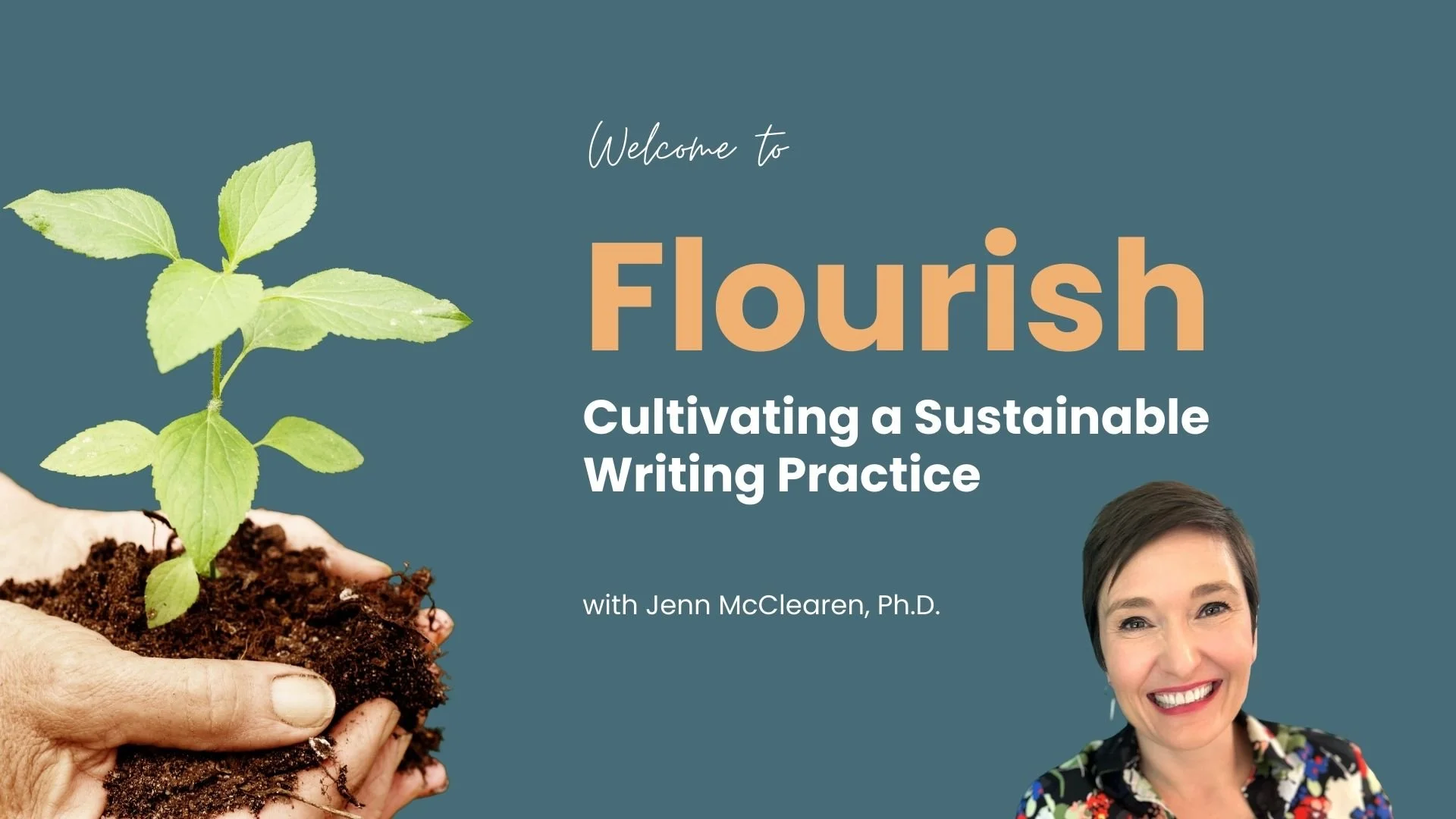
Complementary access to Floursh: Cultivating a Sustainable Writing Practice
A comprehensive 10-module self-paced course that deepens the foundations of your writing practice—tools and frameworks to return to long after our sessions end.
-
Email or WhatsApp support
To connect with me throughout the program for questions, accountabilty, and course correction between sessions
-
A Closing Session
To consolidate what's working and talk through what kind of support—if any—would serve you going forward
Your Investment
$5850
plus VAT in the UK and EU
Using institutional funding? I'll provide whatever documentation your institution needs.
Paying out of pocket? A reduced rate of $5700 and payment plans are available for self-paying clients.
Complementary Access: Flourish Valued at $495
All coaching clients receive complimentary access to Flourish: Cultivating a Sustainable Writing Practice, a 10-module online course.
Flourish is the curriculum that runs alongside our coaching work — giving you the frameworks, vocabulary, and deeper foundations to make sense of what we're building together in sessions.
Think of it as the reading that accompanies the seminar. The concepts we work through together in coaching, Flourish gives you the space to explore more fully—and to return to whenever you need refreshers.
What You'll Gain:
* Build a writing practice that fits your actual life. Flourish gives you the frameworks to write consistently and sustainably — not by working harder, but by working in a way that's designed around how you actually think, work, and live.
* Write with more confidence and less second-guessing. Develop tools for moving through perfectionism, self-doubt, and the fear of putting ideas on the page—so you can spend more time writing and less time negotiating with yourself about it.
* Make your writing time count, whatever you have. Learn to match the right kind of writing work to the time and energy you actually have—so that even a fragmented schedule can produce real, steady progress.
* Find your people and build real accountability. Discover how to create the connections and structures that keep you moving — warm, specific, and built around your work rather than generic check-ins.
* Protect your creativity for the long haul. Understand why rest, play, and recovery aren't luxuries — they're the conditions that make sustained intellectual work possible. Build a practice that lasts beyond the next deadline.
Ready to make serious progress on your book?
Let’s Figure It Out Together
Tell me a bit about your goals or challenges. I’ll be in touch soon to talk through options and see whether working together is the right fit.
I look forward to hearing from you.
⬇
FAQs
-
Developmental editing and coaching serve different—though often related—purposes in your writing life. I always say that editing supports the writing and coaching supports the writer.
Developmental editing focuses on improving a specific piece of writing. An editor will give you detailed feedback on structure, argumentation, clarity, and coherence to help you strengthen a manuscript in progress. It’s about shaping that article, that chapter, that proposal into its best possible form.
Coaching, on the other hand, focuses on you—your process, habits, mindset, and long-term goals as a writer and scholar. Coaching supports you in building the systems and self-awareness you need to write more consistently, reduce avoidance, navigate self-doubt, and make steady progress on high-stakes projects. It’s about creating sustainable practices that help you move forward not just once, but again and again.
Writers often benefit from both modes. Editing can refine your work. Coaching helps you get it written in the first place—and keep writing long after.
I offer the combination of developmental editing and coaching as a feature of the Book Development Program. You can purchase additional developmental editing at the rate of $0.09 per word.
-
Colleagues and supervisors offer valuable disciplinary expertise and can assess the scholarly merit of your work. However, they're often reading quickly, focusing on content over craft, and may not give you detailed guidance on manuscript structure, argumentation, or reader experience.
As a developmental editor, I bring a focused eye specifically for how manuscripts work as manuscripts—how arguments unfold across chapters, how structure supports (or undermines) your claims, how voice and tone shape reader engagement, and how to position your work for its intended audience. I pride myself on being able to articulate clearly what's working, what's not, and giving you actionable guidance for moving your project forward.
I also read with fresh eyes and without the assumptions someone in your immediate field might bring. This means I can identify places where your argument isn't landing clearly, where you're assuming too much knowledge, or where the structure needs rethinking—issues that colleagues close to your work might not catch.
Additionally, developmental editing is a professional service with clear deliverables and turnaround times. You're not asking for a favor or waiting months for feedback. You receive comprehensive, actionable guidance designed specifically to move your manuscript forward.
-
My scholarly expertise is in media studies, communication, cultural studies, gender and sexuality studies, and sports studies. However, I edit work across the humanities and qualitative social sciences more broadly. That's where I can offer the most meaningful support—especially when it comes to argument development, voice, and structure for academic audiences.
This said, I'm also happy to work with scholars in other fields if you're writing a crossover book—a manuscript intended to reach broader audiences beyond specialist readers. If your goal is to make your scholarship more accessible or connect with interdisciplinary or public audiences, I can help you shape the work for that wider impact.
-
I'm open to both approaches, though I particularly enjoy working chapter-by-chapter. This allows the manuscript to improve iteratively—each round of feedback strengthens subsequent chapters as you apply what you're learning.
Regardless of the approach, I typically request an introduction (even in rough form) or book proposal upfront for context. This ensures I can assess how individual chapters build toward your overall book argument.
-
That's completely fine! You have one full year from your start date to use your developmental editing allocation.
The 6-month coaching period focuses on building momentum, establishing sustainable writing practices, and making steady progress—but I understand that life happens, and manuscripts develop at different paces.
Many clients use their editing strategically: getting feedback on a book proposal and sample chapters early in the program, then continuing to write and submitting additional chapters for editing in the months following our coaching sessions. Others may already have a complete draft and use the editing throughout the coaching period.
The key is that you have the flexibility to write and submit your 30,000 words within a full year, allowing you to work at a pace that's realistic for your life and project.
And if you need feedback on more than 30,000 words, you can always add additional developmental editing at $0.07 per word.
The goal isn't perfection or speed—it's steady, meaningful progress on your book project while building the practices that will sustain your scholarly writing life long after our work together ends.
-
Book coaching is a collaborative partnership, not a top-down relationship. I don’t tell you what to do, map out your project for you, or prescribe the path I would take. Instead, I facilitate a process that helps you clarify your goals, uncover what works for you, and build the habits and systems you need to make meaningful progress on your book.
In academia, mentoring and advising often involve guidance based on someone else’s expertise or preferences—“Here’s what I would do” or “Here’s the right way to approach this.” Coaching is different. It recognizes that there is no single correct way to write a scholarly book and that each writer’s strengths, constraints, and working style are unique.
That said, my book-coaching approach integrates both ICF coaching principles and my experience as a former faculty member and published author. This means:
I may offer contextual information about academic publishing so you can make informed decisions.
I may share frameworks, models, or options that help you see your project more clearly.
I will always check in to ensure that any guidance supports your values, your goals, and your way of working—never a predetermined path.
In short:
Mentors and advisors often give you advice and answers that work for them.Coaches help you find your own answers—and build the practices that make your writing sustainable.
My expertise informs the process, but you remain the expert on your project, and together we create a book-writing approach that truly works in real life.
-
Of course, only you can answer that question for yourself! But I invite you to consider what it might be costing you to stay stuck—missed deadlines, ongoing stress, a manuscript that doesn't move forward, and the nagging feeling that you're not reaching your full potential as a scholar.
The professional, emotional, and even financial impacts of a stalled book project can be significant. For scholars working toward tenure or promotion, an unfinished book can contribute to delayed recognition, fewer opportunities, or a more uncertain career path. And the toll it takes—on confidence, well-being, and peace of mind—is just as real.
Book coaching is both a time and financial investment, and it isn't a quick fix. But many clients find that combining developmental editing with writing support makes a meaningful difference—not only in completing their manuscript but also in building the sustainable practices they need for long-term scholarly success.
Everyone's experience is different, and there are no absolutes. But if you're ready to shift out of survival mode and into steady, supported progress on your book, this may be the right next step.
-
Most clients meet with me approximately every other week over the course of 6 months, which provides momentum with space to integrate. That said, we can absolutely discuss meeting more frequently or spreading coaching sessions out to fit your needs.
For example, if you have a pressing deadline you need support on, we could design our work together to span 5 weeks, meeting once a week.
-
You are ultimately responsible for your manuscript, and I encourage you to trust your instincts. I provide recommendations and possibilities, but you decide what to use and what to set aside.
My goal is to illuminate options, not dictate choices—the best revision emerges when you're making informed decisions that align with your vision for the project.
-
Yes, many of my clients use university funds to pay for editing. Typically you connect me with a department administrator and they pay me directly.
-
Yes—flexible payment options are available. You can pay in monthly installments rather than all at once.
I also offer a small number of scholarships for scholars with financial need. If cost is a barrier, fill out the contact form and select that you want to be considered for a scholarship. I’d be glad to talk with you about what’s possible: jenn@jennmcclearen.com.