
WRITING STRATEGY
& STRUCTURE PROGRAM
A coaching program for scholars who are ready for
steady, sustainable forward motion
on their book manuscript.
A book asks you to sustain deep, complex thinking
inside an already full life.
The real challenge is sustaining that work while you
✵ Juggle teaching, research, service, and everything in between
✵ Navigate perfectionism and imposterism in a culture of constant critique and rejection
✵ Manage nonstop demands with little time to think or reflect
✵ Work under the pressure of a publish-or-perish system
You want clarity on what the book needs next and the structure to act on it consistently.
You want a way of working that can adapt when life changes—without losing momentum.
You want confidence in your ideas and how you approach the process of writing a book.
You work best when someone else is there to think through hard decisions with you.
What you need is a process
designed for your actual context,
your actual working conditons,
and the book you're actually writing.


How We Work Together
As your academic writing coach, I'll help you build a writing practice that works in real life—one that moves the book forward consistently, builds confidence, and fits your actual schedule and energy.
We clarify what the book needs now and how academic publishing works, reduce the decision fatigue that comes with long-form scholarly projects, and build momentum that compounds over time. When the plan needs to flex—because it will—we adjust together.
Structure, strategy, and follow-through: that's what this program is for. The book moves further when you're not carrying it alone.
Your Path Forward
-
#1 CLARIFY YOUR FOCUS
We begin by identifying what you and the book need now — cutting through the noise to name clear priorities. You leave the first session knowing exactly what deserves your attention next.
-
#2 BUILD FOR YOUR LIFE
We co-create a writing plan that fits your actual schedule, energy, and circumstances—so that consistency becomes something you build into your life, not something you force against it.
-
#3 SUSTAIN AND ADAPT
With regular check-ins and support between sessions, you keep momentum through heavy teaching periods, caregiving demands, and the inevitable shifts of a full academic life. The plan flexes. The progress continues.
What’s Included in the Strategy & Structure Program
-

An initial Strategy Session
We clarify what's stuck, identify barriers, and establish clear priorities for our work together
-

Four Tailored Coaching Sessions
To support planning, decision-making, and common barriers—perfectionism, procrastination, time pressure, competing demands
-

An Editorial Snapshot
A bird's-eye read of an extended abstract of your book, used as a thinking tool in session to inform strategy and next steps rather than as detailed written feedback
-

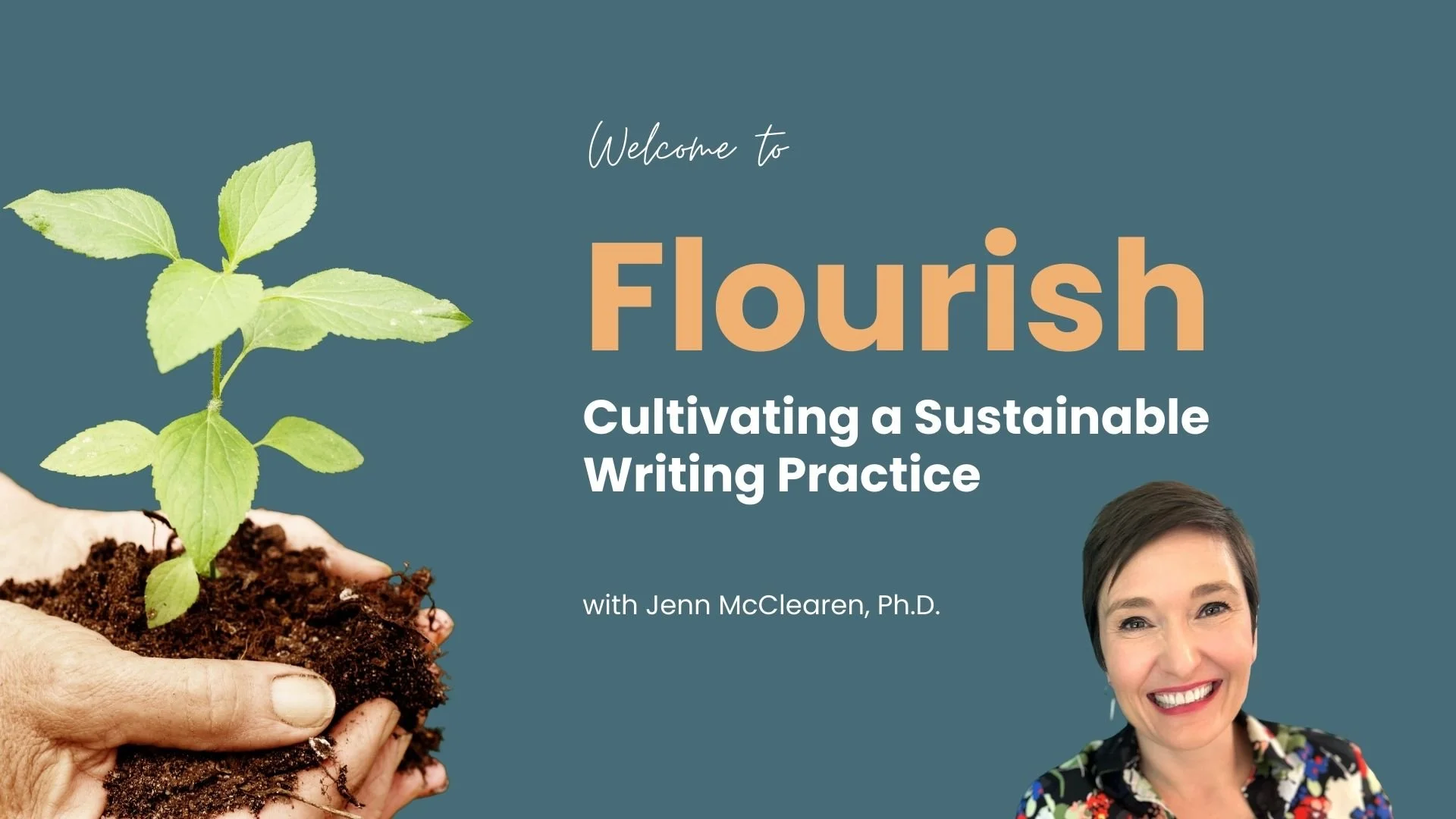
Complimentary access to Flourish: Cultivating a Sustainable Writing Practice
A comprehensive 10-module self-paced course that deepens the foundations of your writing practice — tools and frameworks to return to long after our sessions end.
-

Email or WhatsApp support
Connect with me throughout the program for questions, accountabilty, and course correction between sessions
-

A Closing Session
To consolidate what's working and talk through what kind of support—if any—would serve you going forward
Complementary Access: Flourish Valued at $495
All coaching clients receive complimentary access to Flourish: Cultivating a Sustainable Writing Practice, a 10-module online course.
Flourish is the curriculum that runs alongside our coaching work — giving you the frameworks, vocabulary, and deeper foundations to make sense of what we're building together in sessions.
Think of it as the reading that accompanies the seminar. The concepts we work through together in coaching, Flourish gives you the space to explore more fully—and to return to long after our work together ends.
What You'll Gain:
* Build a writing practice that fits your actual life. Flourish gives you the frameworks to write consistently and sustainably — not by working harder, but by working in a way that's designed around how you actually think, work, and live.
* Write with more confidence and less second-guessing. Develop tools for moving through perfectionism, self-doubt, and the fear of putting ideas on the page—so you can spend more time writing and less time negotiating with yourself about it.
* Make your writing time count, whatever you have. Learn to match the right kind of writing work to the time and energy you actually have—so that even a fragmented schedule can produce real, steady progress.
* Find your people and build real accountability. Discover how to create the connections and structures that keep you moving — warm, specific, and built around your work rather than generic check-ins.
* Protect your creativity for the long haul. Understand why rest, play, and recovery aren't luxuries — they're the conditions that make sustained intellectual work possible. Build a practice that lasts beyond the next deadline.
Client Testimonials
-
![A woman with long, curly brown hair, wearing a white blazer over a black top, and layered necklaces, standing against a dark gray background.]()
"I always leave our sessions feeling empowered and excited to move forward."
Jenn is a gift. She listens in a way that makes me feel completely understood. Because she understands me so well, she can point out when I’m not being 100% honest with myself or when I'm being too hard on myself. Her nudges are always perfectly calibrated to meet me right at my growing edge, helping me move forward without causing overwhelm or anxiety.
What I love most is how fully she understands the context I’m working within—not just the contours but the intricate details. That allows her to offer realistic strategies. And she is never impatient with the minutiae it takes to successfully put them into practice.
Her post-session notes and action plans are incredible—she gives language to my experience in a way that not only reflects what I conveyed but also helps me to better understand myself and my situation. I always leave our sessions feeling empowered and excited to move forward.
Dr. Megan Reynolds, Associate Professor, University of Utah
-
![A woman with short hair and glasses with a tortoise shell pattern, smiling and resting her chin on her hand, sitting at a table in a dimly lit outdoor setting at night.]()
"I’ve learned how to envision the career I want and take actionable steps toward achieving it. "
Jenn has been a steady source of support, encouragement, and guidance. She doesn’t just give advice—she models everything she offers. As her client, I’ve learned how to envision the career I want and take actionable steps toward achieving it.
She’s helped me prioritize the projects that matter most to me and find better ways to manage my time as a neurodivergent person and parent of a neurodivergent child.
Dr. Briana Barner, Assistant Professor, University of Maryland
-
![Close-up of a woman with curly brown hair and blue eyes, wearing a black blazer and a white shirt with a striped collar, smiling outdoors with a blurred green background.]()
"I truly cannot overstate how impactful our work together was."
Working with Jenn during the summer after my first year on the tenure track was so incredibly life-giving.
First, I was able to finally submit (and get an R&R!) on a dissertation paper I had been dragging my feet on as a direct result of our work together. Specifically, Jenn helped me recognize and overcome some specific mindset roadblocks I didn't even realize I had around writing; and she also supported me in articulating and analyzing my writing process clearly for the first time. This fundamentally changed my research process!
Jenn is incredibly kind, supportive, organized, and clear in her communication and approach. I truly cannot overstate how impactful our work together was, and I recommend working with her to anyone who is feeling lost about their research, writing, and/or career!
Dr. Meaghan McSorley, Assistant Professor, Florida State University
-
![Portrait of a smiling woman with shoulder-length dark hair, wearing a teal sleeveless top and a gold necklace, standing outdoors with cars in the background.]()
"These shifts in my mindset have helped me grow more confident as a scholar."
Working with Jenn has helped me transform my relationship to writing. Her attentive listening, suggestions, and positive reinforcement have helped me decrease my anxiety towards writing and remember all the things I love about writing.
Jenn's coaching has helped me think of writing as any other part of my life, rather than a high-stakes "my career depends on this" act of perfection. These shifts in my mindset have helped me grow more confident as a scholar and move towards a daily writing practice.
Dr. Karolina Dos Santos, Postdoctoral Scholar, New York University Gallatin
-
![A smiling woman with dark curly hair, wearing a black shirt, a tan and black striped skirt, pearl accessories in her hair, gold hoop earrings, and a nose piercing, outdoors with a background of blurred trees and foliage.]()
"Jenn is able to decipher an end goal through what felt like my confused rambling."
What I appreciated about working with Jenn is that when you tell her about your project, what you want to accomplish, and what you are having trouble with, she can turn it into tangible and specific goals with solutions. She is able to decipher an end goal through what felt like my confused rambling.
In the time I worked with Jenn, I was able to complete my dissertation, which has now garnered the interest of publishers and is the blueprint for my forthcoming book. Additionally, I was able to write, revise, and publish my first peer-reviewed academic article. Her help is invaluable and neither of these projects could have been completed without her assistance.
Dr. Lily Kunda, Assistant Teaching Professor, The College of William and Mary
-
![A person's hand reaching towards the sun setting over a calm body of water during twilight.]()
"Jenn's support and guidance have empowered me to overcome mental barriers, prioritize my goals, and approach academic writing with renewed confidence and clarity.
Working with Jenn has been transformative—she has helped me cultivate a positive and productive relationship with writing through sustainable routines and clear strategies. Her support and guidance have empowered me to overcome mental barriers, prioritize my goals, and approach academic writing with renewed confidence and clarity.
Anonymous
-
![Close-up of two hands holding each other, one hand visible with a red long-sleeve shirt cuff and the other with several colorful bracelets, against a plain background.]()
"I am so glad I found Jenn at this stage of my career."
Jenn is an amazing coach. She is gentle, receptive, and, most importantly, she has helped me overcome my fears of academic writing. Her structured outlines, discussion point recaps, and clear next steps truly bring clarity to the task at hand. I greatly appreciate her prompt replies and encouraging notes. I am so glad I found her at this stage of my career.
Dr. Muniza Askari, SPJ Singapore Campus







Your Investment
$2000
plus VAT in the UK and EU
Want to use institutional funding? I'll provide whatever documentation your institution needs.
Paying out of pocket? A reduced rate of $1850 and payment plans are available for self-paying clients.

You're deep in a semester—teaching, service, the usual
—and the book is still moving.
Not because everything aligned perfectly,
but because you have a practice that holds even when it doesn't.
You sit down to write with clarity about what the work needs next. The decisions that used to feel paralyzing have become manageable. The momentum you've built doesn't disappear when things get busy—it bends, and then it comes back.
Your most important work is getting the time and attention it deserves. You're making real progress on the projects that matter — without running yourself into the ground to do it.
And when you close your laptop, you actually have something left over for the rest of your life.
Picture this…
You're not just working toward the next deadline. You're building a writing life—and a career—that actually feels like yours.
Let's figure out what your book needs.
Fill out the form below or email me at jenn@jennmcclearen.com.
Tell me about your book and where you are in the process. If you're unsure whether this program or a different level of support is the right fit, we'll figure that out together.
FAQs
-
Developmental editing and coaching serve different—though often related—purposes in your writing life.
Developmental editing focuses on improving a specific piece of writing. An editor will give you detailed feedback on structure, argumentation, clarity, and coherence to help you strengthen a manuscript in progress. It’s about shaping that article, that chapter, that proposal into its best possible form.
Coaching, on the other hand, focuses on you—your process, habits, mindset, and long-term goals as a writer and scholar. Coaching supports you in building the systems and self-awareness you need to write more consistently, reduce avoidance, navigate self-doubt, and make steady progress on high-stakes projects. It’s about creating sustainable practices that help you move forward not just once, but again and again.
I always say that editing supports the writing and coaching supports the writer.
Writers often benefit from both modes. Editing can refine your work. Coaching helps you get it written in the first place—and keep writing long after.
I offer developmental editing as a feature Book Development Program
-
Developmental editing is included as a core feature of my Book Development Program (up to 30,000 words). For the Writing Strategy and Structure Program, I provide a bird's-eye review of an extended abstract of the book.
Because of my own academic background, I specialize in editing work in the humanities and qualitative social sciences. That's where I can offer the most meaningful and field-specific support—especially when it comes to argument development, voice, and structure.
-
That’s exactly why coaching can help. We’ll build strategies that work with your real schedule, not an ideal one. And if a rough week happens, we’ll adjust without judgment.
-
I work with scholars on a wide range of writing projects, including books, journal articles, grant proposals, conference papers, and dissertations. Whether you're working toward tenure, preparing for the job market, or trying to carve out time for a long-delayed project, we can tailor our work together to fit your goals.
Please note that I can offer coaching for any discipline but only offer developmental editing in the humanities and qualitative social sciences.
-
Yes, I work with all of the above! I coach scholars at various stages of their academic journey—from PhD students navigating dissertation writing and early publishing to precariously employed faculty looking to augment their publications for the job market to mid-career faculty balancing research, teaching, service, and leadership responsibilities.
Whether you're just starting out or looking to regain momentum later in your career, I tailor my coaching to meet you where you are and support your goals without adding to the overwhelm.
-
Most clients meet with me approximately every other week over the course of 10 weeks or 6 months, which provides momentum with space to integrate. That said, we can absolutely discuss meeting more frequently or spreading coaching sessions out to fit your needs.
For example, if you have a pressing deadline you need support on, we could design our work together to span 5 weeks, meeting once a week.
-
Of course, only you can answer that question for yourself! But I invite you to consider what it might be costing you to stay stuck—missed deadlines, ongoing stress, projects that don’t move forward, and the nagging feeling that you’re not reaching your full potential.
The professional, emotional, and even financial impacts of stalled progress can be significant. For scholars working toward tenure or promotion, unfinished writing can contribute to delayed recognition, fewer opportunities, or a more uncertain path forward. And the toll it takes—on confidence, well-being, and peace of mind—is just as real.
Coaching is both a time and financial investment, and it isn’t a quick fix. But many clients find that the structure, clarity, and support it offers make a meaningful difference—not only in how much they write but also in how they feel about the work.
Everyone’s experience is different, and there are no absolutes. But if you're ready to shift out of survival mode and into steady, supported progress, this may be the right next step.
Many clients have told me, once they began, I wish I’d started sooner.
-
I want you to feel confident in your decision to invest in coaching. If after the strategy session, you feel like we aren’t a good fit for your needs, then reach out within 48 hours, and I will issue a refund (minus a €300 fee).
-
Yes, many of my clients use university funds to pay for coaching. Typically you connect me with a department administrator and they pay me directly.
-
Yes—flexible payment options are available. You’re welcome to pay in monthly installments rather than all at once, and I’m happy to discuss a longer plan if that would make coaching more accessible.
I also offer a small number of scholarships for scholars with financial need. If cost is a barrier, don’t hesitate to reach out. I’d be glad to talk with you about what’s possible: jenn@jennmcclearen.com.
-
Coaching and therapy can both be powerful forms of support—but they serve different purposes.
Therapy is typically focused on healing, mental health, and addressing past experiences or emotional difficulties that may be interfering with your well-being. Therapists are licensed professionals trained to work with issues such as anxiety, depression, trauma, and other psychological concerns.
Coaching, by contrast, is forward-looking. It’s focused on helping you clarify goals, develop strategies, and build the habits, mindset, and support systems you need to move forward—whether that means finishing your book, navigating academic expectations, or creating a more sustainable writing practice. Coaching is not a substitute for mental health treatment, but it can be a valuable complement if you’re feeling generally well and want guidance, structure, and accountability.